
The Story
Italy in the heart of Old Montreal,
on the ground floor of the Eurostars Hotel, Bambino is the product of seven years of development and more than twenty-five years of experience creating some of Montreal’s grandest and most extraordinary hospitality spaces.
Founded in the early 2000s by John Edward Gumbley, JEGantic Group has built itsreputation around a simple belief:
“A restaurant or nightlife venue should create an emotional experience and feel, as if you’re entering another world”
From Orchid, The Main, Obeko Suite, Rouge, Silver, Muzique, Bord’Elle, The Farsides, Boa Vida Yacht Club, Hang and the internationally recognized Yoko Luna, the group has developed a distinctly maximalist, purposeful more is more approach to hospitality, bringing architecture, interiors, food, cocktails, music, art and entertainment together as part of a singular experience.
Bambino represents the next evolution of that philosophy. The magnum opus.
The Bambino concept itself was born at a hockey game. John told Chef Andrew Bambino
he was working on an Italian concept. Chef Andrew told John that he wanted to open an Italian restaurant of his own. John’s response was simple: “Let’s do it together.” Both men have Italian roots, and what began as a conversation between JEGantic’s founder and its Executive Chef became the starting point for the journey that followed.
John and Andrew have been developing the project for seven years. John shaping the concept and driving it creatively through multiple locations, designs, delays and reinventions while Chef Andrew has been instrumental in the culinary offerings and day-to-day development of Bambino throughout that journey.
What emerged was more personal than the plan ever was.
John calls the process a “beautiful nightmare” and the result “a fantastic masterpiece” adding that it is “our most beautiful place.”
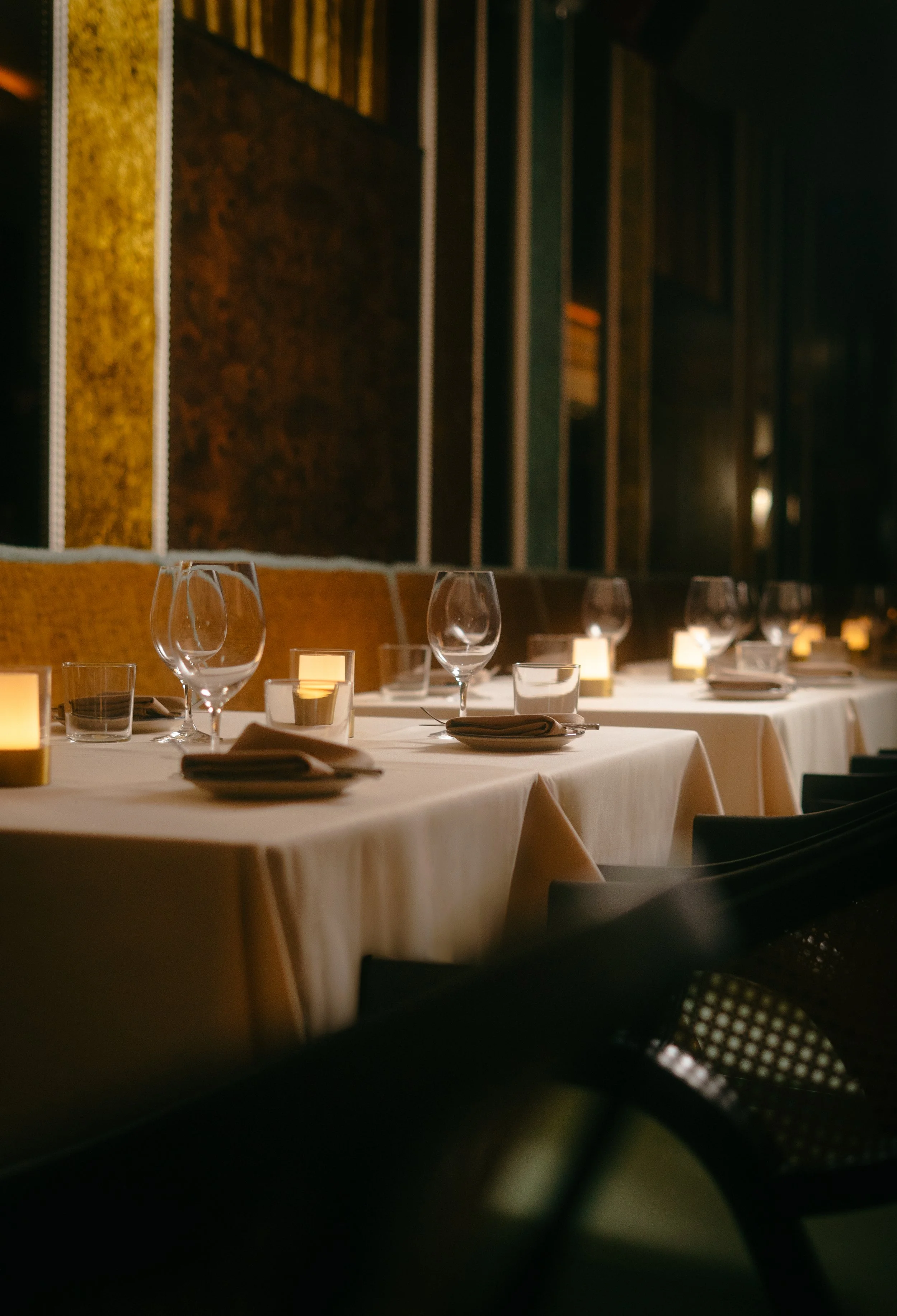
Bambino is built on contrast: classical Italian references against a modernist colour palette, marble against velvet, polished burlwood beside contemporary art. It is elegance without restraint, rich Old World finishes while stepping into the future.
It is unmistakably JEGantic.
But beneath all the lavishness is something quieter and considerably more personal: family.
Seven Years in the Making
Bambino did not begin with a mood board.
It began with years of exploration.
John’s approach to hospitality has always been shaped by travel. Over a lifetime, he has
gathered inspiration from the world’s great restaurants and hotels, but also from the places
that existed long before modern hospitality design did.
For Bambino, he looked to the great cities of Italy, Europe and the Mediterranean, studying
museums, mansions, churches, cathedrals, historic residences and some of the continent’s
most enduring architectural achievements.
What interested him was not simply Italian décor.
It was the confidence with which earlier generations used colour, stone, wood, metal,
ornamentation and scale.
The work of Catalonian architect and designer Antoni Gaudí became an important reference
point: organic forms, unexpected geometry, saturated colours and materials that should not necessarily belong together, but somehow do.
Bambino does not imitate those places. It borrows their freedom.
The freedom to mix periods. To place precious materials freely. To allow classical architecture and contemporary art to occupy the same room. To choose impact over restraint.
Bambino brings those lessons together.
“BAMBINO”
Long before there was a restaurant called Bambino, there was a young cook by the same name.
Chef Andrew Bambino grew up in professional kitchens, often the youngest person on the line among older, old-school cooks.
They called him Bambino, the kid.
The name stayed with him.
After building his career across some of Montreal’s most distinctive restaurants as Executive Chef at JEGantic Group, Bambino brings Chef Andrew back to his own Italian family heritage and to a cuisine he has known his entire life. Not as an exercise in reinvention, but in respect. Italian classics became classics for a reason.
They carry memory, technique, generations of refinement and history. Every dish has a story to tell, a snapshot of something carried over from the Old World to the New.
At Bambino, the ambition is not to replace that history with novelty.
It is to honour it beautifully.
The Beautiful Nightmare
The restaurant Bambino was supposed to become exists only in old drawings and computer files.
Materials disappeared from availability. Measurements changed. Structural requirements altered the proportions of the room. Original finishes could no longer be sourced.
Decisions were made, abandoned and made again.
Eventually, the team stopped trying to recreate the original vision.
The restrained palette became richer. Colour entered. Materials that were never originally intended to meet were placed beside one another. Marble, burlwood, red velvet, exotic granites, precious blue opal, gold and hand-painted surfaces began to sing in unison.
As the complications continued (changing locations, unavailable materials, shifting dimensions and ideas that could no longer be executed as originally intended), John lost countless hours of sleep searching for new materials, new solutions and new ways to hold the project together. At the same time, JEGantic Vice President Kajanan “Kaje” Kandiah kept finding ways to make the numbers work through every change.
Each choice became a response to the one before it, and somewhere in that process, the chaos became part of the design.
John believes the end result could never have been created entirely on purpose. Too many of its defining details came from problem solving, substitutions, accidents and decisions made out of necessity. Nothing ended as it started. What could have compromised the restaurant instead gave it its character.
Beauty is not always found in conforming to what we have been taught to expect. The most beautiful face in a room is often the one with something different about it. Bambino has that same quality.
Its beauty comes not from a single design language but from contrast, tension and unexpected details, and that is precisely what makes it beautiful. The magic, as he sees it, is in everything that went wrong and somehow found its way together.
Design
Some of Bambino’s most expressive details begin with intimate family memories.
Across the restaurant, approximately 6000 individual wooden spheres were cut, placed and finished by hand to create a distinctive architectural texture.
Their inspiration came from a family story about Andrew’s nonna, who would never leave the house for an occasion without first “putting her pearls on.” At Bambino, she still does.
At the entrance, guests pass through a dramatic wrapped corridor before encountering a glowing plane of backlit blue opal etched with the Bambino signature.
Above, hand-painted fresco-style murals depict classical figures across the ceilings.
Inside, custom burlwood panelling (the same used in Rolls-Royce interiors) brings depth and warmth to the room. Double-herringbone flooring moves through the space toward the main stage. Marble appears throughout, including richly veined stone and Rosso Levanto in the bathrooms.
A 30-foot red velvet banquette takes its repeating sculptural rhythm from Savoiardi, the ladyfinger biscuits traditionally used in tiramisu.
And at the centre of the room stands a monumental concrete cherub, transformed by Montreal artist Stikki Peaches in his unmistakably contemporary style.
Personal references to John’s late mother and Andrew’s nonna are integrated into the work itself, bringing famiglia into one of Bambino’s most prominent works of art.
Revisited Classics
If the design is where Bambino allows itself freedom, the kitchen is where it exercises restraint.
Chef Andrew’s menu is built around Revisited Classics: beloved dishes drawn from across Italy and approached with exceptional ingredients, traditional foundations and disciplined execution.
At its core, Bambino is about truly authentic Italian food. Bambino is not interested in reinventing.
It is interested in making something worthy of the tradition.
The ingredients behind those dishes are the result of years of research and attention. Bambino has developed private-label tomatoes and cold-pressed olive oil sourced from Puglia, while lemons arrive from the Amalfi Coast.
That same philosophy extends to the way Bambino is meant to be eaten: together, with dishes shared across the table.
The wine program remains entirely Italian, built around private imports selected to accompany the food.
Two central island bars anchor the room, serving wine and champagne alongside classic and signature cocktails and non-alcoholic creations curated by renowned mixologist and Patrón Brand Ambassador Jason Cabanillas.
An Occasion Again
Bambino is also built around a belief that has become increasingly rare in contemporary hospitality:
Going out should still feel like going out.
As hospitality has progressively become more casual, Bambino deliberately moves in the opposite direction.
The restaurant is being created for a sophisticated clientele and for the rituals that once surrounded a great evening out: dressing well, meeting somewhere beautiful, handing the keys to the valet, sitting down to dinner and allowing the night to become an occasion.
Bambino will cultivate a semi-formal to formal culture where elegance feels natural rather than imposed.
Helping shape that culture is General Manager Justin Sabini, a longtime fixture of Montreal’s high-end dining scene. Italian himself, Sabini’s career includes the iconic Buonanotte, as well as Fishbone, Koko and JEGantic’s own Yoko Luna, where he served as General Manager, bringing years of experience creating the kind of warm, polished hospitality Bambino is built around.
Beautiful dresses. Jackets. Champagne at the bar. Tables filled with friends and family. Dates that feel like dates. Business dinners where you aren’t the only ones in suits.
A place putting the effort in to be worthy of you putting the effort in. A mutual respect and appreciation between restaurant and client.
The intention is not to recreate another era.
It is to bring the best of that era back.
Bambino is an Italian restaurant shaped by memory, experience and imagination.
Behind it are seven years of development and more than twenty-five years of JEGantic creating hospitality experiences in Montreal.
The food looks back with respect.
The space looks forward without asking permission.
Somewhere between the two is a restaurant that could only have been made this way: through years of experience, changed plans, stubborn attention to detail and the willingness to allow something to become more interesting than what was originally intended.